

1,3-Dibromopropane
Hosea Chem® has been supplying 1,3-Dibromopropane (CAS 109-64-8) with high quality and competitive price for many years, covering most of the European, American, middle east, etc. Send Inquiry
Product Description
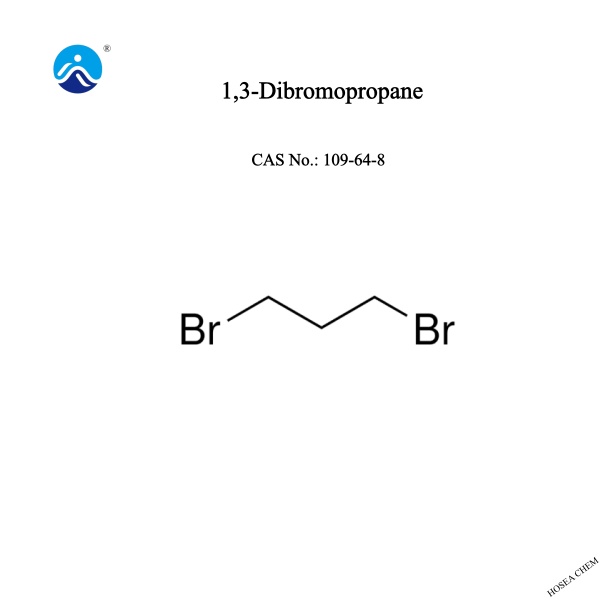
1,3-Dibromopropane
Manufacturing method: 1,3-Dibromopropane is obtained by reacting propylene glycol with hydrobromic acid. First, concentrated sulfuric acid and 1,3-propanediol are added to hydrobromic acid, and then concentrated sulfuric acid is slowly added dropwise. The mixture is refluxed on a sand bath for 7 hours, and then the crude product is distilled off. The crude product is washed once with water, then 2-3 times with 10% sodium thiosulfate solution, and twice with 10% sodium carbonate solution. The aqueous layer is separated, and the product is dried with anhydrous calcium chloride. The product is obtained by fractional distillation at atmospheric pressure, collecting the fraction at 159-168℃.
Specification of Product
Product Name : 1,3-Dibromopropane
Trimethylene Bromide

CAS No.: 109-64-8
Molecular Formula: C3H6Br2
Molecular Weight: 201.89
Freezing point: -34.2℃
Boiling point: 165℃ (167.3℃), 59-63℃ (2.66kPa), 55.6℃ (1.33kPa)
Relative density: 1.9822 (20/4℃)
Refractive index: 1.5232
Flash point: 54℃
Soluble in ether, acetone, and chloroform; insoluble in water
Decomposes upon prolonged heating, partially transforming into 1,2-dibromopropane
Boiling with water produces propylene glycol. Odorless, sweet taste, hygroscopic
1,3-Dibromopropane specification
Appearance: colorless to light yellow liquid
Purity: ≥ 99.0%
Dissociative bromine: ≤ 0.01%
Water content: ≤ 0.2%
Color: ≤ 20
1,3-Dibromopropane Applications
Sibutramine and other pharmaceutical intermediates, as well as intermediates in organic synthesis. Used in the manufacture of cyclopropane.
1,3-Dibromopropane Packaging
250 Kgs /Drum
1,3-Dibromopropane Storage
Pack and preserve the product in a sealed, cool and dry condition, and avoid contacting strong oxidants.